Posts

Abstract & Works Cited

 Abstract The most prevalent and universal issue that most people are facing is the COVID pandemic. Many people are having to face supplemental challenges that would not have been so affecting before. The pandemic has changed the lives of many people, including the lives of college students and faculty. The issue for most students and faculty is the transition from in-person learning to remote learning. This paper will explore the issue of how the shift has aggravated the mental health of college students. Moreover, this paper will help better understand how the transition to remote learning impacted certain sectors of the student population. Furthermore, social isolation due to the pandemic has forced first generation college students in particular to face the issue of “belonging” at college. This paper will discuss how “belonging” creates an environment of perceived isolation for this sector. The privatization of public higher education further intensifies this issue because it i...
Literature Review #5

Image
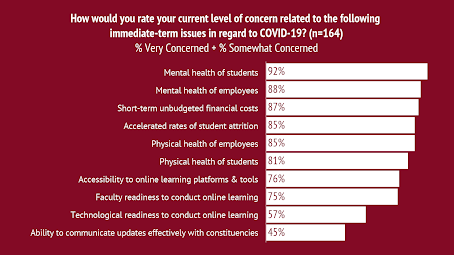
Students Struggle but Don’t Seek Colleges’ Help About the Author Melissa Ezarik is a editor, journalist, and content manager. At Inside Higher Ed, she writes and manages content from the Student, Voice hub, that features analysis of and pespective of current college students. She also writes on other topics such as K12 education leadership, special education, personal finance, enterprise technology, construction and architecture, and career/workplace issues. Citation Inside Higher Ed. “Students Struggling but Not Seeking Campus Mental Health Support.” Inside Higher Ed, 14 Apr. 2021, www.insidehighered.com/news/2021/04/14/students-struggling-not-seeking-campus-mental-health-support.   Summary This article discusses how student do not take advantage of thier instiution's couseling services because they believe that it would not be helpful for them. Greater number of people beleive that thier mental health has been negatively impacted by the pandemic. Although, only few percent ...

Argument & Counter-Argument

 Argument The COVID pandemic  has brought additional challenges such as financial stress and lack of connectivity to faculty and students which has led to loss of sense of belonging to the institution.  Counter-argument Many argue that the university cannot do anything about this issue due to the social isolation. Many students don’t feel comfortable to engage in class because they feel like they do not belong. Faculty and the institution should find ways to engage students in conversation so they can feel free to engage.The article " Students Struggling but Not Seeking Campus Mental Health Supports" discusses that students are not reaching out to colleges which is why they cannot help them. The article " Seven Practices for Building Community and Student Belonging Virtually" helps to build an debate that can occur. The article explains how colleges and universities is a big part of why do not belonging. The reason they are not reaching out is because they have no...

Case

Image
Michelle Obama One of the prime examples of a successful first generation college student is former first lady Michelle Obama. Former first lady gives advice to first generation students who are pursuing higher education. She mentions how important belonging is at college and how she is also an first generation graduate. This is extremely useful because it shows that first generation students have the ability to suceed, but they just need support from instituions and others around them. This video is former first lady's speech from the obama white house .   ABC News. “Michelle Obama’s Inspiring Message to First-Generation College Students: ‘There Are so Many People Who Believe in You.’” Michelle Obama’s Inspiring Message to First-Generation College Students: “There Are so Many People Who Believe in You,” uploaded by ABC News, 16 Aug. 2018, abcnews.go.com/GMA/News/michelle-obamas-inspiring-message-generation-college-students-people/story?id=57144691.

Theoretical Frame

 T he concept of belonging was introduced by Baumeister & Leary. The fulfillment of need to belonging  must be satisfied by two criterias. Individuals must frequently interact with other people in the group and the interaction should express a long lasting affective concern for each other’s welfare. Since this is a need, if it is not satisfied than there will be distress and negative consequences. One of the main reason for first generation college students challenges is the lack of sense of belonging.  Some things that affects first generation students sense of belonging is their relationship with people and themeselves. The article "Fostering College Students’ Sense of Belonging Amidst COVID-19" discusses about microagressions and how they effect their want to succeed. The article " First-Generation Students' Sense of Belonging, Mental Health, and Use of Counseling Services at Public Research Universities." discusses about the belonging concept how it effe...

Literature Review #4

Image
Seven Practices for Building Community and Student Belonging Virtually   About the Authors  Justin Beauchamp is interning with Ithaka S+R’s Educational Transformation team. Currently, they are a PhD student in the sociology program at the CUNY Graduate Center. Justin worked professionally in higher education in student affairs. Justin compeleted Masters Degree at Bowling Green State University in college student personnel and Bachelors Degree at the University of Connecticut in social identity development.  Emily Schwartz is an program manager in Ithaka S+R with the Educational Transformation team. Emily worked for the Strategic Education Research Partnership where she supported K-12 programs. She worked for the education office of Senate HELP commitee as a graduate in Washington DC. Emily completed her Master's Degree at Georgetown University in public policy and Bachelors Degree at College of William and Mary in government....

Visual

Image
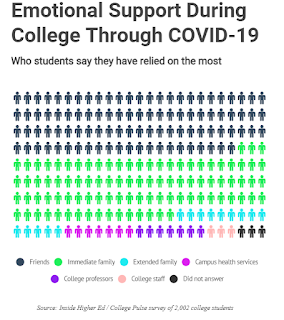
  This visual shows various facts about college students during COVID pandemic. This clearly indicates that the pandemic has worsened thier college experience and this shows how hard it has been for first generation students. Many first generation students have had to drop out because either they could not afford it or they were unmotivated to succeed. Many student's parents have lost jobs which was their source of income. It has affected thier mental health. 

Research Question & Current Work Cited

Research Question   How has the transition to remote learning affected the student's? How has this transition had a negative or positive effect on college students? If it has positively impacted, what are some coping methods that college students found most useful during this time? How has this transition had a negative effect on college students' mental health? How has it affected the first generation students more than others? How has social isolation changed the defined “belonging” for first generation college students? Bibliography Anderson, Benedict. Imagined Communities: Reflections on the Origin and Spread of Nationalism . Revised, Verso, 2016. Browning, Matthew H. E. M., et al. “Psychological Impacts from COVID-19 among University Students: Risk Factors across Seven States in the United States.” PLOS ONE , edited by Chung-Ying Lin, vol. 16, no. 1, 2021, p. e0245327. Crossref , doi:10.1371/journal.pone.0245327. “Digital Mental Health Interventions for Depression, Anxiety...

Literature Review #3

Image
  Imagined Communities: Reflections on the Origin and Spread of Nationalism About the Author  Benedict Anderson was born on August 26, 1936. He had Anglo-Irish father and English mother. Benedict received schooling in California. Benedict Anderson graduated from the University of Cambridge with high honours. He was also awarded a Ph.D. in government by Cornell University in 1967. He was most famous for this book, Imagined Communities.  Citation  Anderson, Benedict Richard O'Gorman. Imagined Communities:  Reflections On the Origin and Spread of Nationalism. E-book, London: Verso, 2006, https://hdl-handle-net.proxy.libraries.rutgers.edu/2027/heb.01609. Accessed 1 Mar 2021. Summary  Benedict Anderson develops the concept of imagined communities in nationalism. The community that he describes is of a nation where people believe that they are part of the community. Entrepreneurs were printing in local languages in order to maximize circulation. He calls nationa...

Literature Review #2

Image
Finding My Way: Perceptions of Institutional Support and Belonging in Low-Income, First-Generation, First-Year College Students. About the Author  Darris R. Means is an associate professor at University of Pittsburgh in Educational Foundations, Organizations, and Policy. He earned his Ph. D at North Carolina State University in Educational Research and Policy Analysis with a concentration in Higher Education. When he wrote this article, he was an associate professor at University of Georgia. Prior to that, he was a n administrator at Elon University for Elon Academy, a college success and access program for students  with financial need or first generation students. He is currently working on a participatory action research study and a multi-phase study. The participatory research is about factors that support black students’ science degree determination. The multiphase study is about postsecondary education access and success for Black youth and the barriers they face.  ...

Research Proposal

A Working or Tentative Title How First Generation Students are Impacted by Social Isolation Topic Description      The most prevalent issue that most people are facing currently is the COVID pandemic. Most people are having to face issues that might have not been so affecting before. The issue for most students and faculty is the transition from in person learning to remote learning. I will be exploring the issue of how social isolation has aggravated the mental health of college students. Furthermore, this paper will help better understand how the transition to remote learning impacted certain sectors of the student population. In addition, due to social isolation these sectors have faced the issue of “belonging” at college. The privatization of public higher education further intensifies this issue because it is a challenge for low income students to prioritize their education during this time where they have additional responsibilities. Research Question How has the tr...

Literature Review #1

Image
COVID-19 Remote Learning Transition in Spring 2020: Class Structures, Student Perceptions, and Inequality in College Courses About the Authors Alanna Gillis (picture to the left) is an assistant professor at St Lawrence University. She is in the sociology department and graduated with a PhD from UNC-Chapel Hill in May 2020. Gillis does research on inequality in higher education leading to inequality reproduction and examines the behaviors of college students before, during, and after college. Some awards and honors that she received are the Graduate Contributions to the Sociological Scholarship of Teaching and Learning Award,  2020 Tanner Teaching Assistants Award for Excellence in Undergraduate Teaching at UNC, the 2020 Wilson Award for exceptional undergraduate teaching from the Sociology Dept at UNC, and the 2019 SAGE Publishing Keith Roberts Teaching Innovations Award. Laura M. Krull (picture to the right) is an assistant professor of sociology at St. Norbert College in De Pere...

Research Question and 3 Scholarly Sources

Research Question During this pandemic, many students have had to transition their lives from in-person learning to remote learning. How has the transition affected the student's mental health? How has this transition had a negative or positive effect on college students' mental health? If it has positively impacted, what are some coping methods that college students found most useful during this time? If negatively impacted, how has their poor mental health affected their ability to learn? How has the student's mental health affected the people around them (family, classmates, and faculty members)? Why would students prefer in school learning over remote learning or the other way around? 3 Scholarly Sources  Gillis, Alanna, and Laura M. Krull. “COVID-19 Remote Learning Transition in Spring 2020: Class Structures, Student Perceptions, and Inequality in College Courses.” Teaching Sociology , vol. 48, no. 4, 2020, pp. 283–99. Crossref , doi:10.1177/0092055x20954263. Kecojevic...

Scouting the Territory

Update on where I stand on the intial topic idea After conducting more research, I have decided to continue with the topic that I chose in the intial blog post. The topic that I had intially chosen was about the impact of covid on college student's mental health. I beleive this is a crucial topic that is impacting many college students especially during this time, where they are isolated from others.  Online Research Results  While, researching about this topic I came through some terms that are directly associated with this topic. A term that was constantly used in many articles that is an mental health issue were depression, anxiety, p sychological distress . When I searched up 'depression in college students', most of the articles that appeared were related to COVID. The other key terms had similar results. Wikipedia article titled 'Mental health during the COVID-19 pandemic' showed similar key terms that appeared on other articles and not only related to the US,...

Initial Topic Idea

Image
The topic that I am interested in is the mental health impacts due to remote learning. College has become more difficult due to less physical interaction, not only for the students but also for the faculty. Some mental health issues that I might want to research are depression, stress, anxiety, and dementia during online learning. I want to know if these issues are due to remote learning or something else. I am interested in this topic because it was an issue that many people were facing even before COVID, but I want to research if it impacted students' mental health.